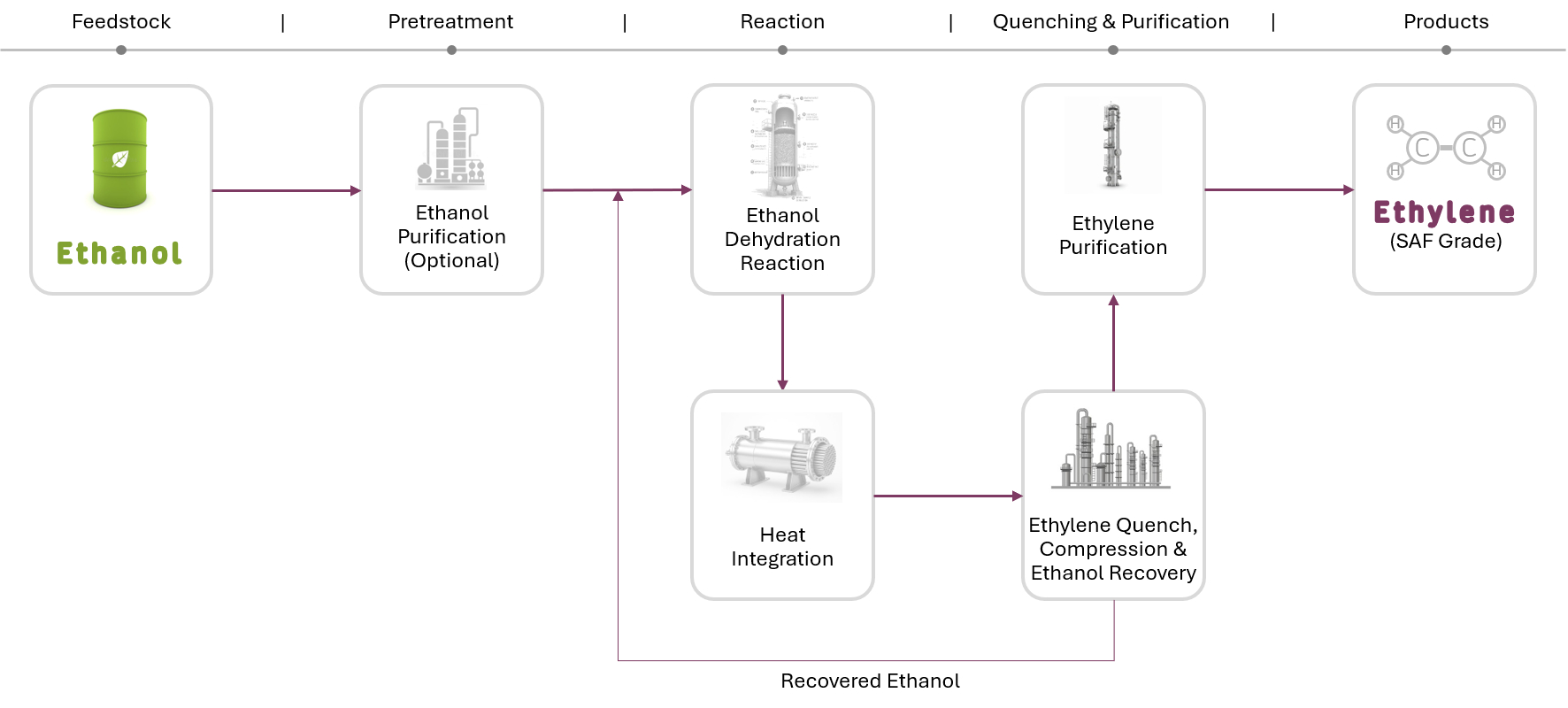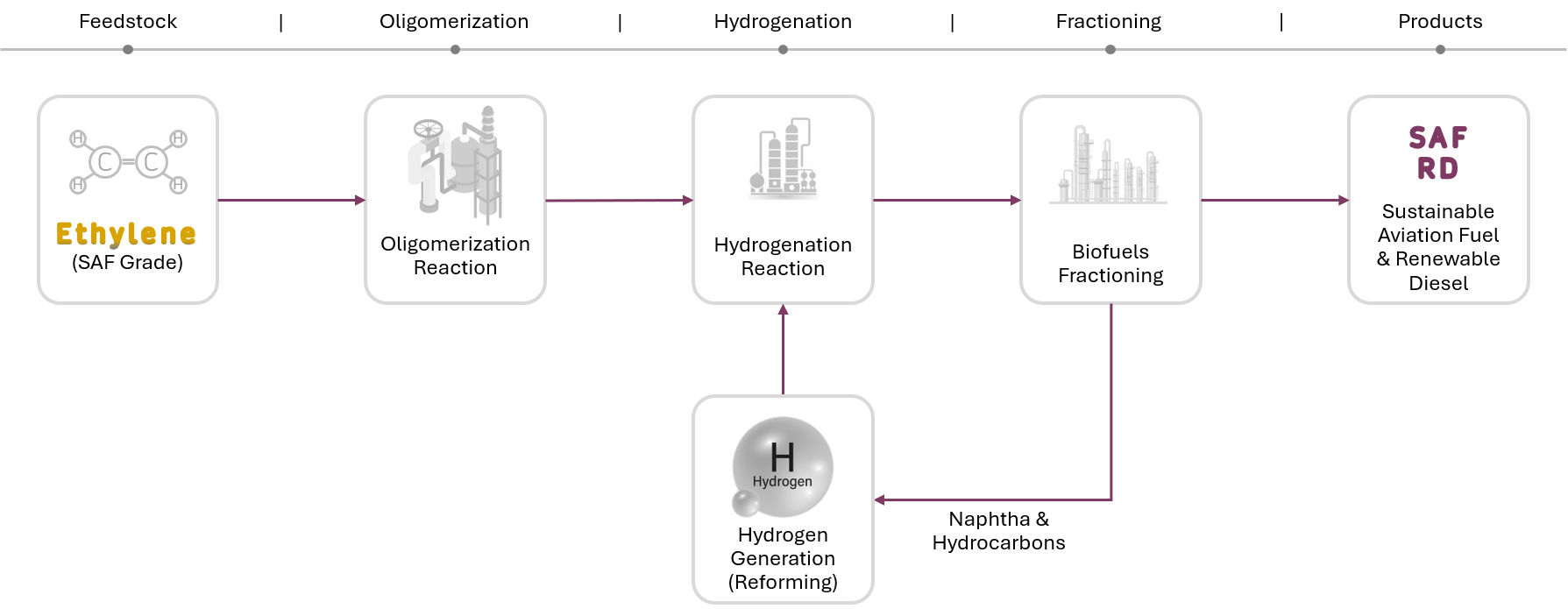

Petron converts renewable ethanol into SAF through an integrated Alcohol-to-Jet platform designed for high yield in SAF production. Light hydrocarbons generated during fractionation are reformed internally to supply the hydrogen required by the process, reducing dependence on external hydrogen infrastructure.
Petron has been involved in the development of SAF (ATJ) technology for over 10 years across the USA and Japan. As a global leader in the first critical step of the SAF (ATJ) process, Ethanol to Ethylene, Petron is fully familiar with the complete SAF technology platform.
Petron’s solution & differentiators
Petron develops Sustainable Aviation Fuel (SAF) solutions based on an integrated Alcohol-to-Jet (ATJ) platform that converts renewable ethanol into aviation-range hydrocarbons. The process combines established licensed conversion technology with Petron’s expertise in ethanol production, biorefinery integration, utilities, and renewable-fuel project development.
Integrated ATJ platform
Petron’s scope extends beyond the core ATJ conversion technology. We integrate the complete process chain, from renewable ethanol supply through product storage and loading, into an optimized biorefinery and utility system.
Typical process scope
- Renewable-ethanol supply from G1.0, G1.5, and G2.0 biorefinery platforms
- Ethanol dehydration and renewable-ethylene production
- Catalytic oligomerization to form aviation-range hydrocarbons
- Hydroprocessing, product stabilization, and finishing
- Product fractionation into SAF, renewable diesel, and light-hydrocarbon streams
- Light-hydrocarbon reforming and internal hydrogen generation
- Product storage, blending, quality control, and loading facilities
- Steam, power, cooling water, refrigeration, nitrogen, fuel gas, water-treatment, and wastewater systems
- Heat recovery, process optimization, emissions control, and process-safety systems
Why Petron
- High SAF selectivity: an ATJ configuration designed to direct approximately 95% of product output toward SAF, with a smaller renewable-diesel co-product stream.
- Integrated hydrogen solution: internal reforming of light hydrocarbon streams supplies the hydrogen needed for the process, reducing external hydrogen dependency.
- Renewable ethanol integration: direct connection between G1.0, G1.5, and G2.0 ethanol platforms and downstream aviation-fuel production.
- Maximized carbon utilization: light hydrocarbons are internally upgraded into hydrogen rather than relying on separate hydrogen-production infrastructure.
- Complete plant integration: process engineering covering conversion, hydrogen management, product separation, utilities, heat recovery, storage, loading, safety, and environmental systems.
- Flexible project development: adaptable configurations based on ethanol availability, site infrastructure, product logistics, capacity requirements, and target aviation-fuel markets.
- Lifecycle-focused design: project-specific carbon-intensity analysis and traceability support for credible environmental and market claims.
Product quality and compliance
The ATJ process produces aviation-fuel blendstock that meets the fuel-quality, certification, traceability, and blending requirements used in commercial aviation.
Applicable feedstocks & products
G1.0, G1.5, and G2.0 ethanol into SAF, with internally produced hydrogen and a smaller renewable-diesel co-product stream.
Commercial maturity
Petron along with its technology development partners would provide complete ATJ (SAF) technology in a single package for demonstration and commercial units. The technology has been demonstrated in pilot units.
Full technical brief in preparation with the Petron technology team.
Discuss this technology
Request a technical brief or open a licensing / JV conversation to evaluate your case with our process team.