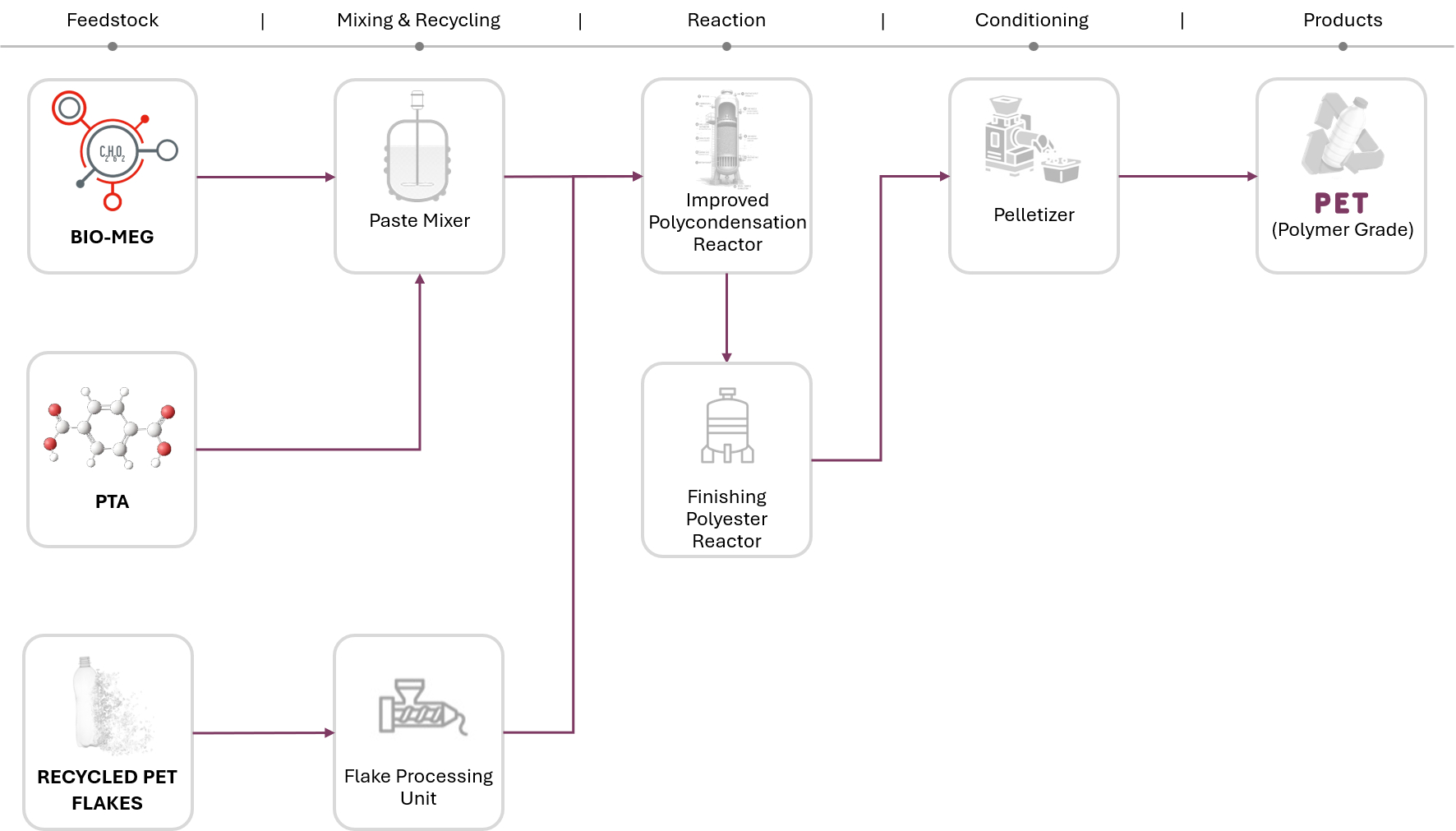
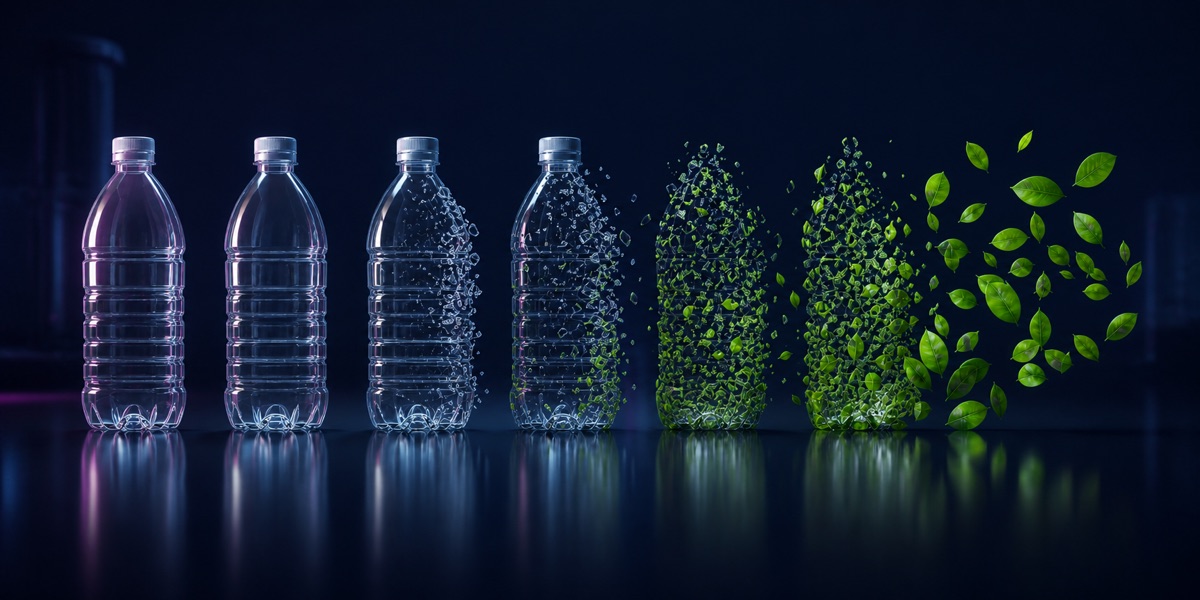
Petron integrates renewable Bio-MEG from ethanol with PTA and recycled PET flakes to produce Bio-Circular PET solutions for packaging, fibers, and polyester applications, combining renewable carbon, circular materials, and advanced process integration.
Petron’s solution & differentiators
Petron’s Bio-PET platform combines renewable Bio-MEG from its ethanol-to-HPEO/glycols technology with purified terephthalic acid (PTA) and recycled PET (rPET) flakes from post-consumer bottles. The integrated approach is designed to reduce reliance on virgin fossil-based MEG while supporting circular use of existing PET material in packaging, fibers, and other polyester applications. Petron’s ethanol-to-ethylene, ethylene oxide, and ethylene glycol technology is positioned to produce Bio-MEG, a key PET raw material.
PET resin is produced through the reaction of PTA and MEG. In this platform, Bio-MEG supplies the renewable glycol component, while recycled PET flakes can be incorporated as a circular raw-material stream subject to the required process route and final-product specification.
Bio-MEG is a drop-in chemical equivalent for PET production when it meets the required specification. Its use enables conventional PTA-to-PET polymerization chemistry while introducing renewable carbon into the glycol portion of the polymer.
PTA is the acid component required for PET resin production and is reacted with MEG during esterification and polycondensation. In a conventional Bio-PET configuration, PTA may remain fossil-derived; therefore, the material should be described as partially bio-based PET, rather than fully bio-based PET. Petron can evaluate future pathways for renewable PTA integration as technologies and feedstock availability mature. A PET resin can be described as fully bio-based only when both its MEG and PTA components are demonstrably derived from renewable feedstocks.
Post-consumer PET bottles can be collected, sorted, washed, ground into flakes, decontaminated, and processed into rPET feedstock. The suitability of rPET flakes depends on contamination level, color, intrinsic viscosity, moisture, trace impurities, and the requirements of the intended final application. High-temperature washing, melt filtration, degassing, and solid-state polycondensation are among the treatments used in high-quality bottle-to-bottle recycling configurations.
The use of rPET reduces demand for virgin PET inputs and extends the value of material already in circulation. Bio-PET can also enter existing PET recycling systems, enabling renewable and recycled content to coexist within established collection and recycling infrastructure.
Flexible product configurations
Petron can evaluate Bio-PET solutions according to the desired balance of renewable and recycled content:
| Configuration | Primary inputs | Suggested market description |
|---|---|---|
| Bio-PET | Bio-MEG + PTA | Partially bio-based PET, assuming conventional PTA |
| Circular PET | PTA/MEG-derived PET + rPET | PET with recycled content |
| Bio-Circular PET | Bio-MEG + PTA + rPET flakes | PET incorporating renewable and recycled content |
| Fully bio-based PET | Bio-MEG + renewable PTA | Future pathway: only applicable when renewable PTA is available and verified |
Why Petron
- Renewable glycol integration: Bio-MEG derived from Petron’s ethanol-to-HPEO/glycols process, directly linked to renewable ethanol availability.
- Combined circularity and renewable carbon: a platform that can combine Bio-MEG with rPET flakes, increasing the share of non-virgin fossil-derived inputs.
- End-to-end process knowledge: integration from biorefinery ethanol through glycols, PET polymerization, recycling, resin finishing, and product logistics.
- Flexible feedstock strategy: capability to assess Bio-MEG, PTA, rPET flakes, and future renewable-aromatics pathways according to project economics and market requirements.
- Quality-driven engineering: process configurations tailored to resin application, color requirements, intrinsic viscosity, contaminant control, and applicable food-contact requirements.
- Scalable project development: solutions can be developed as standalone Bio-MEG production, integrated PET resin production, rPET upgrading, or a complete bio-circular PET complex.
Applicable feedstocks & products
Bio-MEG, purified terephthalic acid, and recycled PET flakes into Bio-PET for packaging, fibers, and polyester applications.
Commercial maturity
Commercially available through Petron’s co-development partnerships, integrated with the wider biorefinery platform.
Full technical brief in preparation with the Petron technology team.
Discuss this technology
Request a technical brief or open a licensing / JV conversation to evaluate your case with our process team.