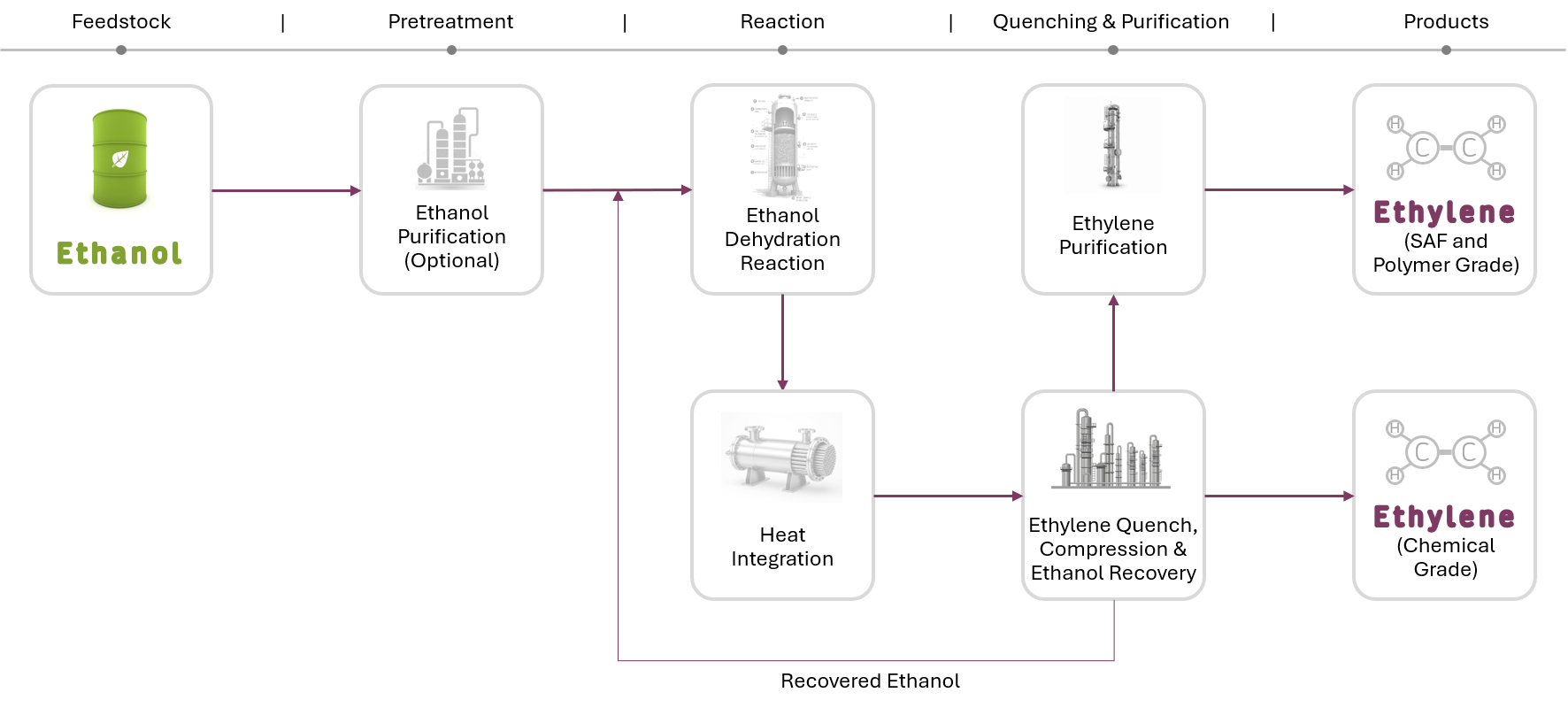

Renewable ethylene is the gateway molecule of the bio-based chemical economy. Petron’s ethanol-to-ethylene (EtE) technology dehydrates bioethanol into polymer-grade ethylene that is chemically identical to its fossil counterpart, and therefore a true drop-in across existing downstream value chains.
Problem / market driver
Ethylene is the world’s most-produced organic chemical, and almost all of it is made from fossil naphtha or natural gas. Brand owners, polymer producers, and regulators are now demanding fossil-free, traceable feedstocks, but without forcing changes to proven downstream processes. A drop-in renewable ethylene unlocks that transition with minimal disruption.
Petron’s solution & differentiators
Petron licenses a complete EtE process (catalyst, process design, engineering package, commissioning, training, and startup) that produces chemical, SAF, and polymer-grade renewable ethylene from ethanol. Because the output is identical to conventional ethylene, it integrates directly into existing polyethylene, ethylene-oxide, and glycol plants.
- The leading ethanol-to-ethylene technology, licensed globally, with almost four decades of proven commercial experience
- Proven catalytic dehydration with high selectivity to ethylene
- Flexible across first- and second-generation ethanol feedstocks
- Designed to plug into existing downstream petrochemical infrastructure
Applicable feedstocks & products
Feedstock flexibility (1G & 1.5G sugar/non-edible grain ethanol and 2G cellulosic ethanol) feeds a broad product slate: renewable ethylene for bio-polyethylene, and the upstream molecule for Bio-EO/Bio-EG and the renewable PET value chain.
Commercial maturity
Commercially deployable, with engineering packages available for licensing today.
Specific conversion, selectivity, and reference-plant figures are maintained by the Petron technology team and provided under a technical brief / NDA.
Where it fits in an integrated biorefinery
Renewable ethylene is the first conversion step in Petron’s Integrated Biorefinery platform, feeding bio-HPEO, bio-glycols, renewable PET, polymers, SAF, EDC, VCM, PC, and other derivatives from a single ethanol backbone.
Discuss this technology
Request a technical brief or open a licensing / JV conversation to evaluate EtE for your feedstock, capacity, and geography.