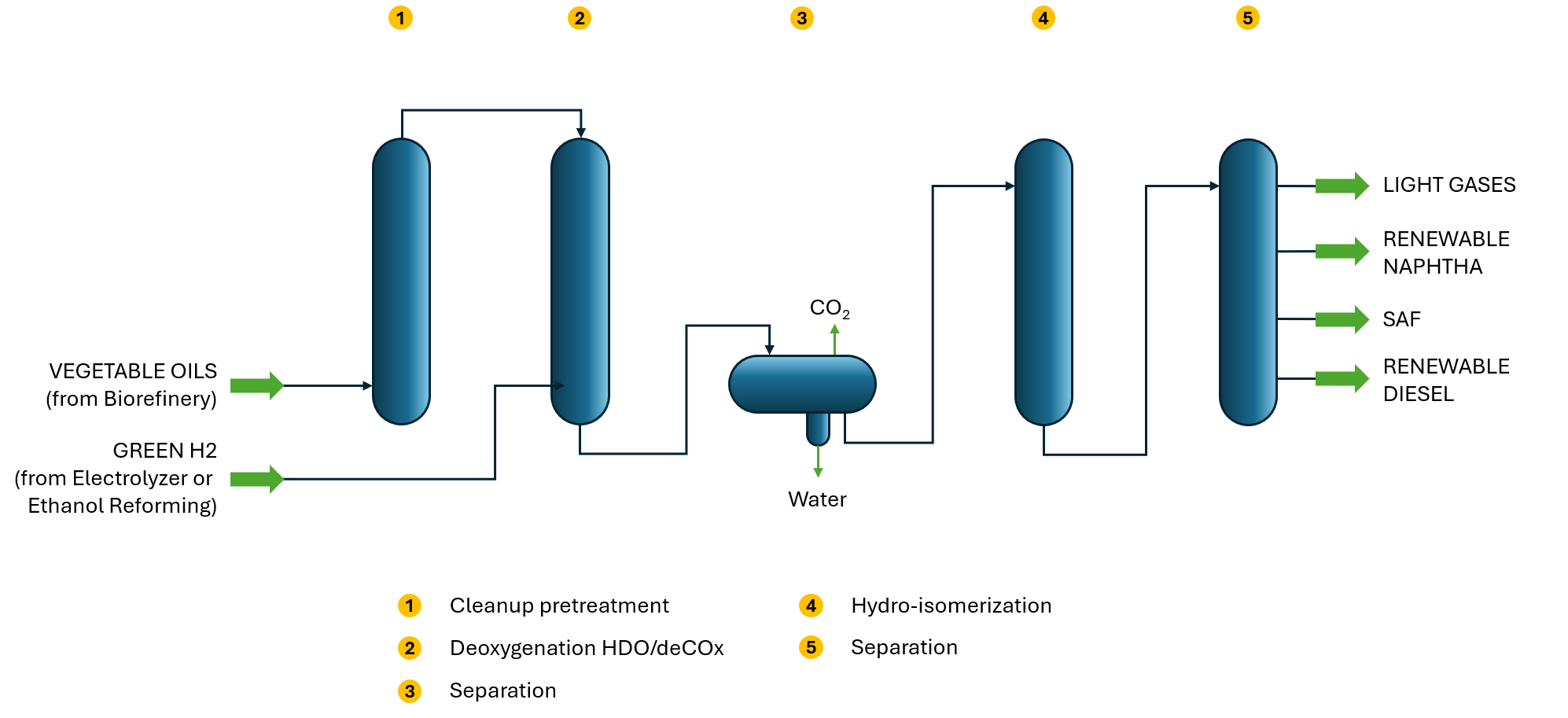
Petron converts renewable oils from G1.0 and G1.5 ethanol biorefineries into renewable diesel through integrated HEFA processing, creating additional value from biorefinery co-products while supporting lower-carbon fuel production.
Petron’s solution & differentiators
Petron develops integrated renewable diesel solutions based on the Hydroprocessed Esters and Fatty Acids (HEFA) route. The process converts renewable oils generated within Petron’s G1.0 and G1.5 ethanol platforms into high-quality hydrocarbon fuels that can be used as drop-in blending components or finished renewable diesel, subject to applicable product specifications and regulations.
By linking ethanol production with renewable-oil recovery and hydroprocessing, Petron creates an additional pathway to maximize the value of biorefinery co-products while reducing dependence on fossil-derived diesel fuels.
Petron evaluates the complete renewable diesel value chain, from biorefinery oil generation to finished-product storage and dispatch.
Typical process scope
- Renewable-oil recovery from G1.0 and G1.5 ethanol operations
- Feedstock collection, storage, blending, and quality management
- Pretreatment to remove water, solids, gums, metals, phosphorus, and catalyst poisons
- Hydrotreating and hydrodeoxygenation using hydrogen
- Hydroisomerization to improve cold-flow properties where required
- Product separation, stabilization, fractionation, and finishing
- Renewable diesel, renewable naphtha, and LPG-range co-product handling
- Hydrogen supply, recycle-gas management, compression, and purification
- Utilities, wastewater, emissions-control, safety, and storage integration
Hydrogen integration
Hydrogen is a critical input to the HEFA process. Petron can assess hydrogen supply from conventional, low-carbon, or renewable sources according to the project’s economics, infrastructure, and carbon-intensity objectives. For lower-carbon configurations, renewable-electricity-based hydrogen from partner electrolyzer technology can be integrated with the renewable diesel complex. Petron may also evaluate its ethanol-to-hydrogen pathway, currently under development, as a potential future option for biorefinery sites with ethanol availability and opportunities for close energy integration.
Why Petron
- Integrated biorefinery approach: links renewable-oil recovery from G1.0 and G1.5 ethanol production with downstream HEFA conversion.
- Feedstock-to-fuel capability: addresses oil recovery, pretreatment, hydroprocessing, product separation, storage, and logistics as one integrated system.
- Hydrogen flexibility: evaluates conventional, low-carbon, and renewable hydrogen strategies, including electrolyzer integration through technology partners.
- Utility optimization: identifies heat recovery, steam integration, power demand, cooling requirements, water use, and hydrogen-recycle opportunities.
- Co-product valorization: supports the production and management of renewable diesel, renewable naphtha, LPG-range hydrocarbons, and more.
- Project-specific design: tailors the process to feedstock availability, oil quality, desired fuel specification, climate requirements, hydrogen source, and market access.
The carbon-intensity performance of renewable diesel depends on the complete project configuration: renewable-oil feedstock origin, land-use and agricultural assumptions, transport, pretreatment, hydrogen source, process fuel, electricity, allocation methodology, and co-product treatment. Petron supports project-specific lifecycle and carbon-intensity assessments rather than applying generic emissions claims.
Applicable feedstocks & products
Renewable oils from G1.0 and G1.5 ethanol biorefineries, hydroprocessed with hydrogen into renewable diesel, with renewable naphtha and LPG-range hydrocarbons as co-products.
Commercial maturity
Commercially available through Petron’s co-development partnerships, integrated with the wider biorefinery platform.
Full technical brief in preparation with the Petron technology team.
Discuss this technology
Request a technical brief or open a licensing / JV conversation to evaluate your case with our process team.