Petron integrates nitrogen from air separation, renewable hydrogen, and captured biogenic CO₂ from G1.0, G1.5, and G2.0 biorefineries to develop scalable pathways for green ammonia and lower-carbon urea production.
Petron’s solution & differentiators
Green ammonia solutions
Petron develops integrated green-ammonia solutions that combine nitrogen from air separation with low-carbon hydrogen to produce ammonia for fertilizer, chemical, energy, and emerging hydrogen-carrier applications.
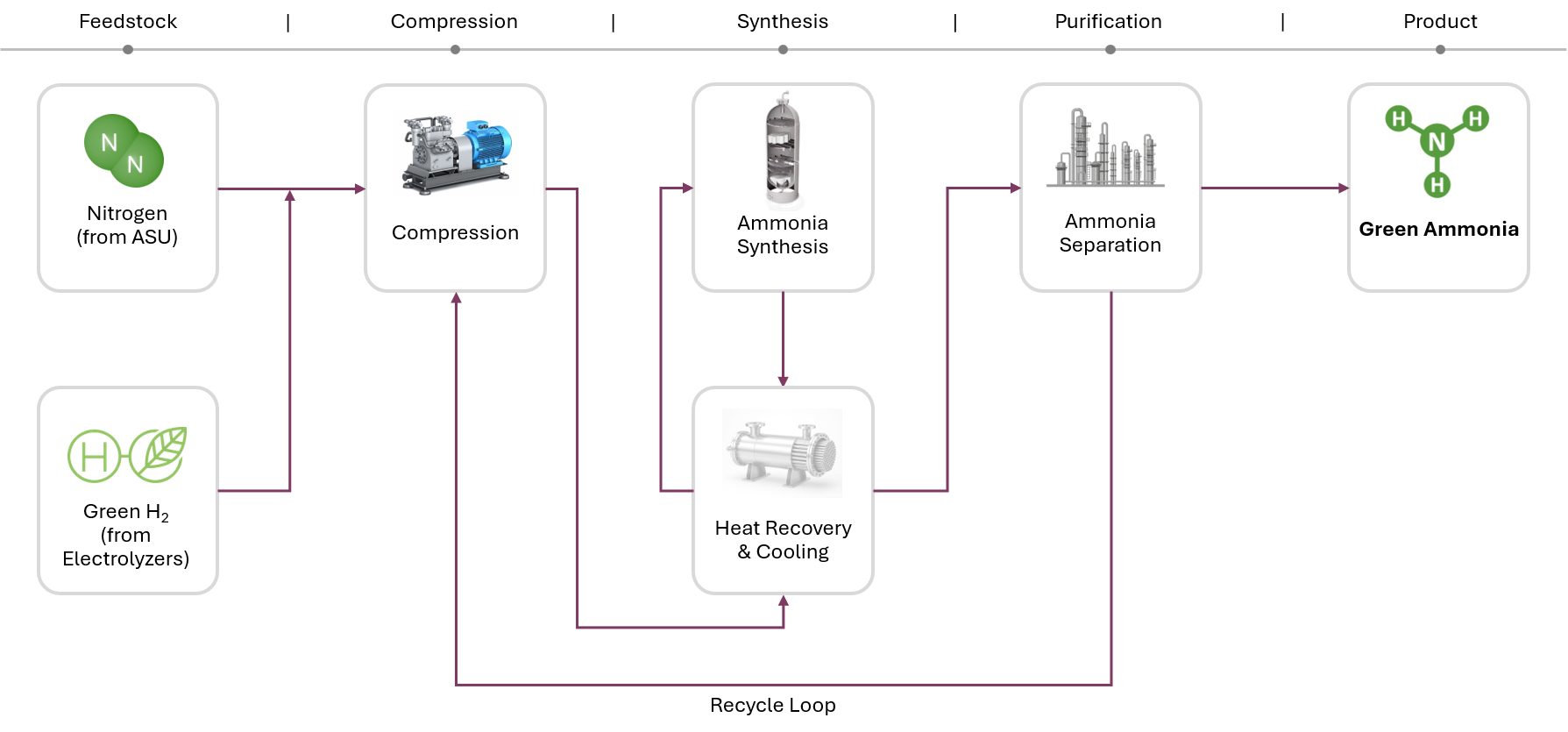
Our approach connects three essential process blocks: nitrogen production from an air separation unit (ASU), hydrogen supply through renewable-electricity-based electrolysis or other qualified low-carbon sources, and ammonia synthesis in an optimized, integrated production system.
Integrated production platform
Nitrogen is supplied from an ASU, where air is separated to produce the high-purity nitrogen required for ammonia synthesis. Hydrogen can be sourced through water electrolysis using renewable electricity, implemented through selected technology partners and integrated by Petron within the overall plant design.
The purified nitrogen and hydrogen streams are conditioned, compressed, and supplied in the appropriate ratio to the ammonia-synthesis loop. Petron evaluates the full process chain, including feed-gas preparation, compression, refrigeration, storage, utilities, heat recovery, and site infrastructure.
Flexible hydrogen pathways
Petron’s green-ammonia platform is designed to accommodate multiple hydrogen-supply strategies:
- Renewable-electricity-based hydrogen: hydrogen produced by water electrolysis using renewable electricity and integrated through Petron’s partner technology network.
- Renewable hydrogen from ethanol: a Petron ethanol-to-hydrogen reforming pathway currently under development, intended as a potential complementary hydrogen source for sites with renewable ethanol availability and advantageous biorefinery integration.
- Hybrid project configurations: designs that evaluate production flexibility, hydrogen storage, power availability, operating continuity, and phased capacity growth.
Why Petron
- Integrated process engineering: design that connects ASU, hydrogen production, ammonia synthesis, utilities, storage, and downstream conversion as one industrial system.
- Biorefinery integration: experience with renewable-carbon streams, ethanol production, steam and power systems, water management, and CO₂ capture.
- Technology flexibility: a platform designed around project conditions rather than a single hydrogen-production route.
- Energy optimization: identification of opportunities for compression optimization, heat integration, steam generation, cooling-system design, and recovery of useful energy.
- Downstream value creation: green ammonia can be produced as a saleable product or used as an intermediate for low-carbon nitrogen products.
Low-carbon urea from green ammonia and biogenic CO₂
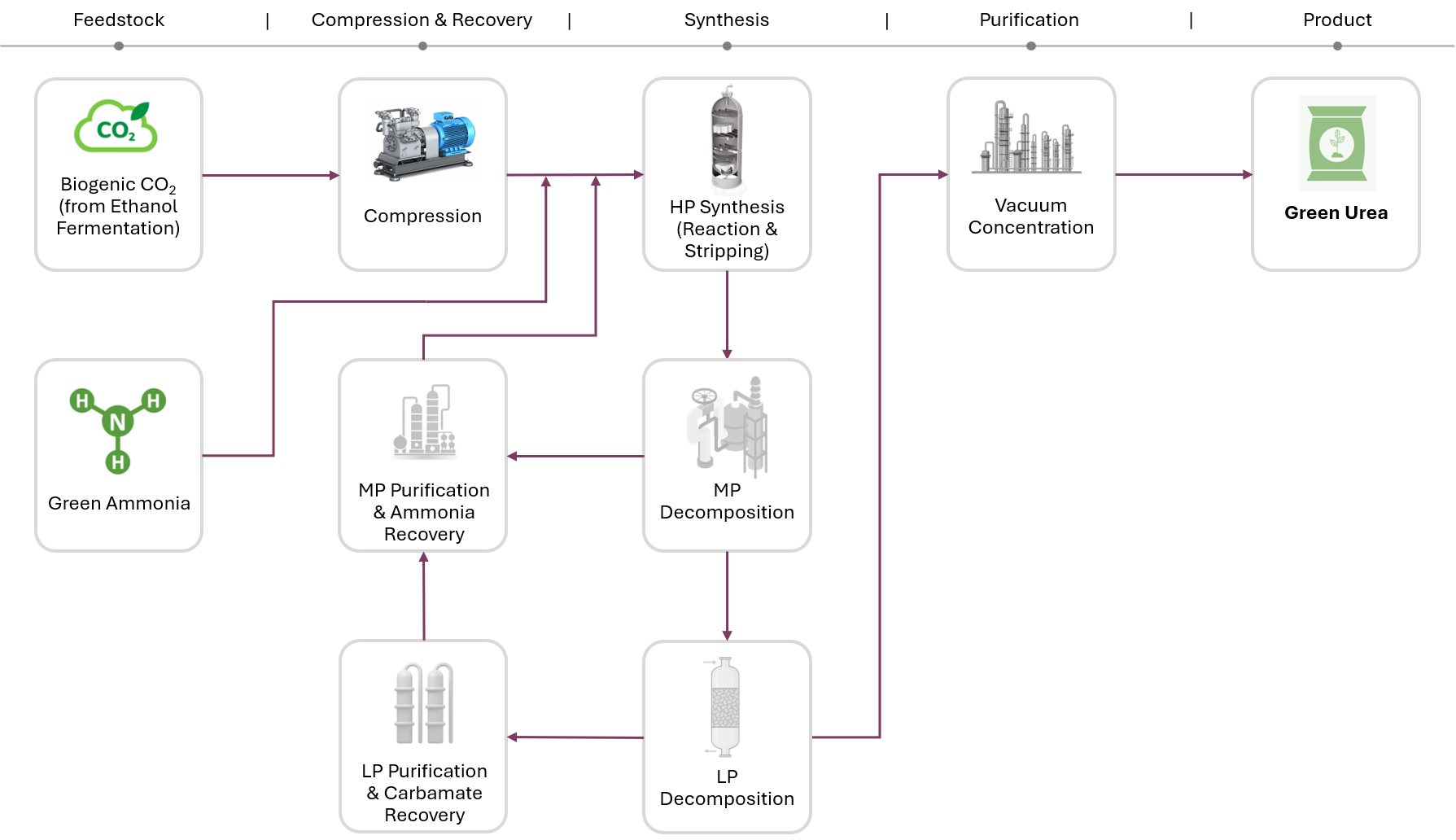
Petron integrates green ammonia with purified biogenic CO₂ to support the production of lower-carbon urea. This pathway combines renewable or low-carbon hydrogen, nitrogen from air, and renewable carbon captured from biorefinery operations to create a high-value nitrogen fertilizer product.
The CO₂ is sourced from raw biogenic streams generated during Petron biorefinery configurations, including first-generation (G1.0), G1.5, and second-generation (G2.0) technologies. After capture, purification, compression, and conditioning, the CO₂ can be supplied to the downstream urea-synthesis process.
From biogenic carbon to fertilizer
Urea is conventionally produced by reacting ammonia with carbon dioxide. In Petron’s integrated concept, the ammonia can be produced from nitrogen supplied by an ASU and hydrogen generated through renewable-electricity-based electrolysis or, subject to further development and validation, Petron’s ethanol-to-hydrogen technology.
This creates a potential circular-carbon pathway: biogenic CO₂ generated during renewable-fuel production is captured and upgraded into urea rather than released directly to the atmosphere. The resulting lifecycle performance depends on the ethanol feedstock, power source, process energy, CO₂ capture efficiency, and final fertilizer-use impacts.
Biorefinery integration
Petron’s biorefinery portfolio provides multiple potential sources of raw biogenic CO₂:
- G1.0 biorefineries: fermentation-derived CO₂ from conventional ethanol production.
- G1.5 biorefineries: integrated platforms that expand the use of feedstocks, co-products, utilities, and renewable-carbon streams.
- G2.0 biorefineries: advanced pathways that convert lignocellulosic or other non-food renewable biomass into fuels, intermediates, and biogenic-carbon streams.
Each project requires specific characterization of CO₂ flow rate, pressure, composition, contaminants, moisture content, purification requirements, and operating continuity before selection and design of the capture and conditioning system.
Our integration capability
Petron evaluates the complete value chain from biorefinery CO₂ generation to finished urea:
- Biogenic-CO₂ characterization, capture, purification, dehydration, compression, and storage
- ASU integration and nitrogen supply
- Green-hydrogen production, conditioning, storage, and compression
- Ammonia-synthesis integration
- Urea synthesis, recovery, concentration, finishing, storage, and loading
- Steam, power, cooling water, condensate, and water-treatment integration
- Heat recovery and energy-efficiency opportunities across the combined complex
- Lifecycle-emissions assessment and carbon-accounting support
Petron’s renewable hydrogen-from-ethanol technology is currently under development. Its operating performance, commercial configuration, capacity, hydrogen specification, carbon intensity, and deployment schedule remain subject to research, validation, engineering, and project-specific assessment.
Applicable feedstocks & products
Nitrogen from an air separation unit and green hydrogen into green ammonia; green ammonia and purified biogenic CO₂ into green urea.
Commercial maturity
Commercially available through Petron’s co-development partnerships, integrated with the wider biorefinery platform.
Full technical brief in preparation with the Petron technology team.
Discuss this technology
Request a technical brief or open a licensing / JV conversation to evaluate your case with our process team.