Petron captures and purifies fermentation-derived biogenic CO₂ from integrated biorefineries, converting a renewable-carbon co-product into a feedstock for lower-carbon urea, ethylene carbonate, and qualified food and beverage applications.
Petron’s solution & differentiators
Petron integrates biogenic CO₂ capture and purification into its biorefinery technologies, converting fermentation-derived CO₂ from a co-product stream into a valuable resource. Our solutions are designed for our G1.0, G1.5, and G2.0 biorefinery configurations or existing biorefineries, supporting the beneficial use of captured carbon in fertilizers, chemicals, and food-related applications.
Fermentation CO₂ can provide a concentrated biogenic carbon source. Through appropriate capture, purification, dehydration, compression, and quality-control systems, Petron helps prepare this stream for selected downstream markets and conversion routes.
From fermentation to value
During ethanol fermentation, sugars are converted into ethanol and carbon dioxide. Instead of venting this renewable-carbon stream, Petron’s integrated approach enables its recovery and upgrading for productive use.
The final capture and purification configuration is designed around the incoming gas composition, impurities, moisture content, production profile, pressure, required product specification, storage requirements, and intended end use.
Typical system scope
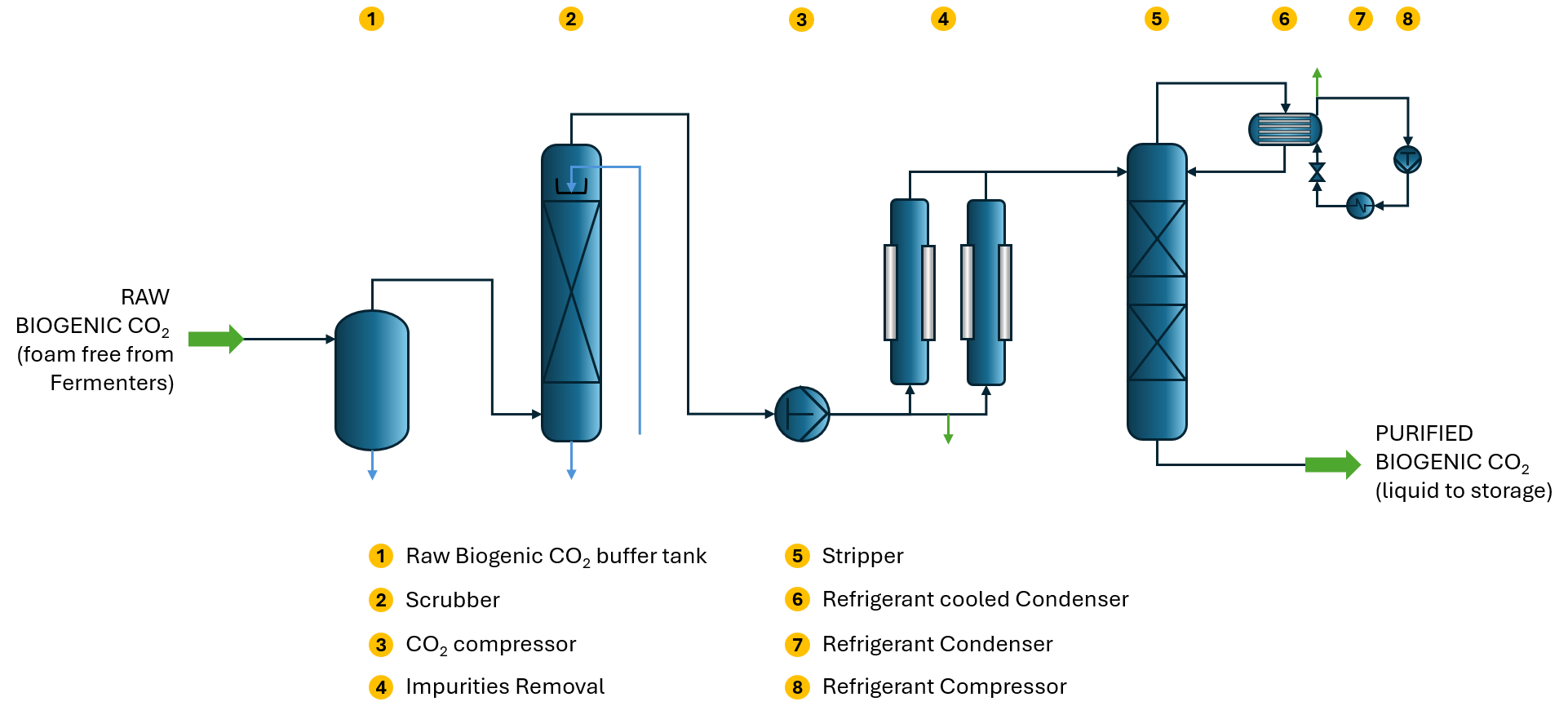
- Fermentation CO₂ collection and gas handling
- Removal of entrained liquids, aerosols, ethanol vapors, and other contaminants
- Gas purification and polishing
- Dehydration and moisture control
- Compression, liquefaction, storage, and loading systems, where required
- Online quality monitoring and product-specification control
- Integration with biorefinery steam, cooling, power, water, and condensate systems
- Safety, vent management, and operating-flexibility design
Multiple product pathways
Captured and purified biogenic CO₂ can be directed to several high-value applications, depending on its quality, local infrastructure, product demand, and project economics.
| Application | Role of purified biogenic CO₂ | Petron integration approach |
|---|---|---|
| Lower-carbon urea | Reacted with ammonia to produce urea fertilizer | Integrates captured biogenic CO₂ with green or low-carbon ammonia produced from ASU nitrogen and qualified hydrogen pathways |
| Ethylene carbonate (EC) | Used as a carbon-containing reactant in selected chemical-conversion routes | Evaluates CO₂ quality, purification needs, conversion technology, utilities, and product-separation requirements |
| Food and beverage CO₂ | Used for carbonation, chilling, freezing, packaging, and other approved applications | Designs purification and quality-control systems capable of meeting the relevant customer, market, and regulatory specifications |
Why Petron
- Biorefinery-based carbon source: direct integration with fermentation units across G1.0, G1.5, and G2.0 biorefinery platforms.
- End-to-end perspective: from raw fermentation gas through purification, compression, storage, and final product use.
- Multiple value pathways: flexible design for fertilizer, chemical, and food or beverage CO₂ opportunities.
- Process-integration expertise: optimization of power, steam, cooling, water, condensate, and heat-recovery systems.
- Product-specification focus: capture and purification systems tailored to the technical and commercial requirements of each end market.
- Scalable deployment: modular and phased configurations that can expand with ethanol capacity, CO₂ availability, and downstream demand.
Applicable feedstocks & products
Raw biogenic CO₂ from the biorefinery fermentation unit into purified biogenic CO₂ for green urea, e-methanol, ethylene carbonate, and qualified food and beverage applications.
Commercial maturity
Commercially available through Petron’s co-development partnerships, integrated with the wider biorefinery platform.
Full technical brief in preparation with the Petron technology team.
Discuss this technology
Request a technical brief or open a licensing / JV conversation to evaluate your case with our process team.