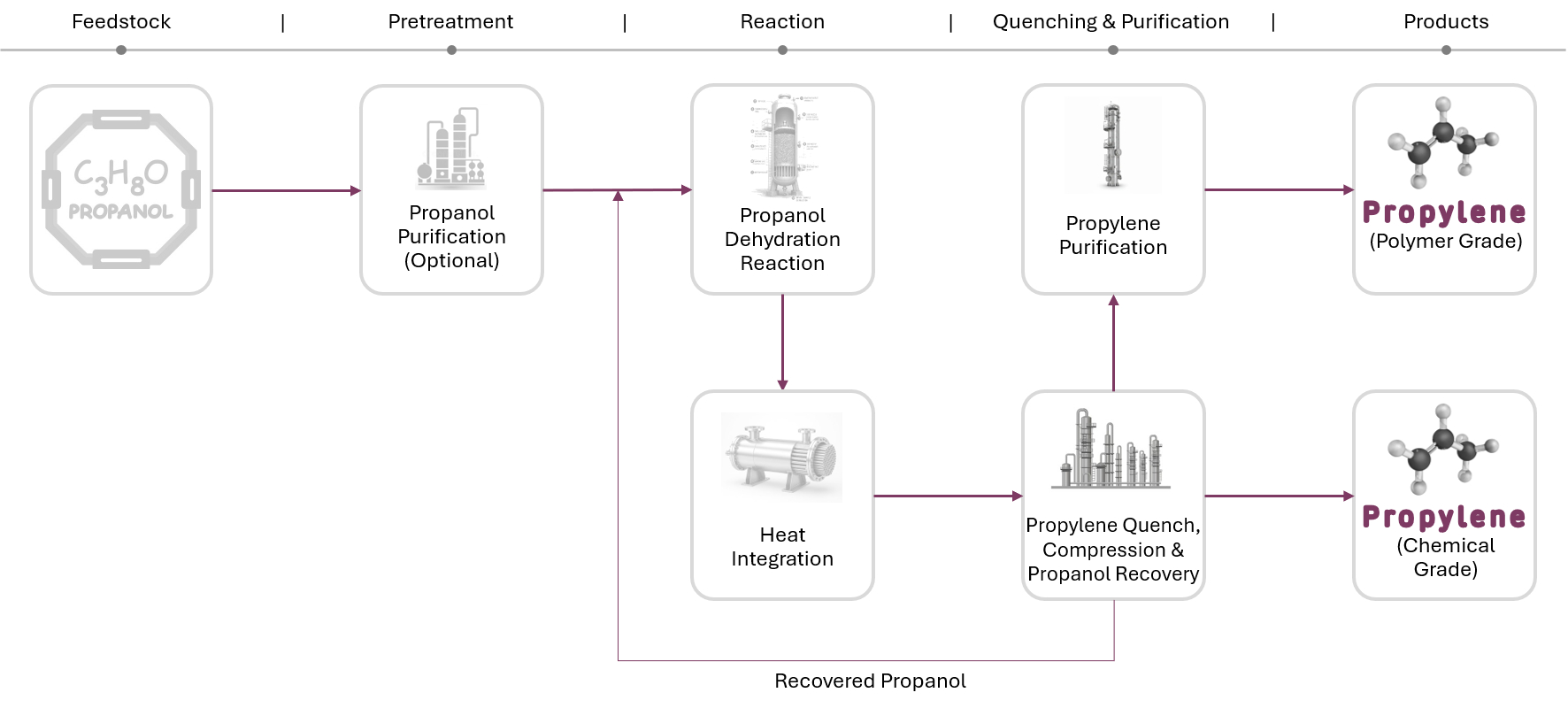
Petron’s propanol-to-propylene (PtP) technology converts bio-propanol via catalytic dehydration into polymer and chemical-grade propylene. Chemically identical to its conventional fossil counterpart, this renewable monomer acts as a seamless drop-in across established downstream value chains.
Problem / market driver
Propylene is a foundational organic chemical with massive global volume, yet nearly all conventional supply is derived from fossil naphtha or natural gas.
Today, brand owners, polymer producers, and environmental regulators are demanding traceable, fossil-free feedstocks. However, shifting to renewable alternatives cannot come at the expense of forcing capital-intensive changes to proven downstream manufacturing assets. A true drop-in, renewable propylene unlocks this sustainable transition with zero operational disruption.
Petron’s solution & differentiators
Petron licenses a complete propanol-to-propylene process (catalyst, process design, and engineering package) that produces polymer-grade renewable propylene from bio-propanol (fermentation). Because the output is identical to conventional propylene, it integrates directly into existing polypropylene, propylene-oxide, and propylene glycol plants.
- The leading propanol-to-propylene technology, licensed globally by Petron
- Proven catalytic dehydration with high selectivity to propylene
- Feedstock flexibility, accepting various bio-propanol grades
- Designed to plug into existing downstream petrochemical infrastructure
Applicable feedstocks & products
Propanol feeds a broad product slate: renewable propylene for bio-polypropylene, and the upstream molecule for Bio-PO/Bio-PG.
Commercial maturity
Commercially deployable, with engineering packages available for licensing today.
Specific conversion, selectivity, and reference-plant figures are maintained by the Petron technology team and provided under a technical brief / NDA.
Where it fits in an integrated complex
Renewable propylene is the first conversion step in Petron’s Integrated Solution platform, feeding polypropylene, bio-PO / bio-PG, and other derivatives from a single propanol backbone.
Discuss this technology
Request a technical brief or open a licensing / JV conversation to evaluate PtP for your feedstock, capacity, and geography.