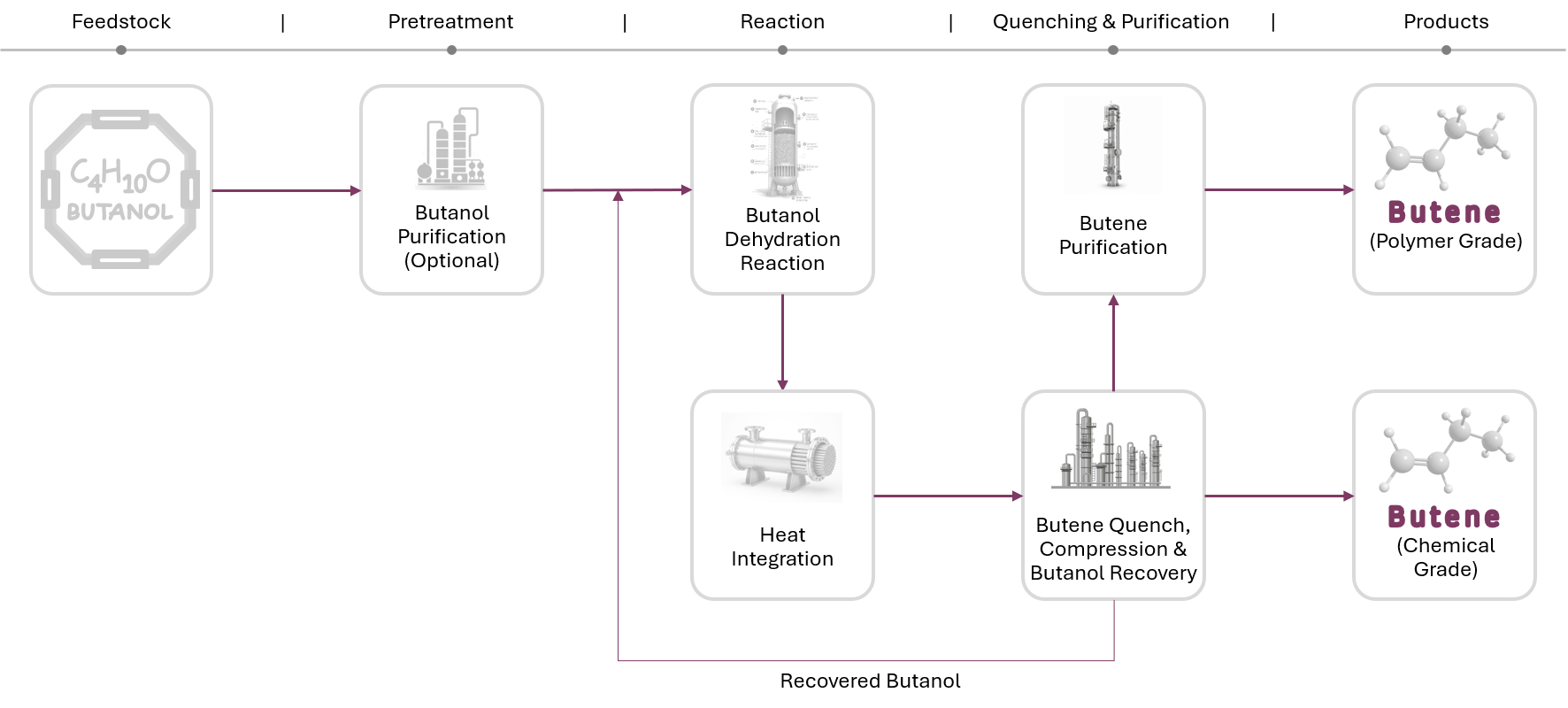
Petron’s butanol-to-butene (BtB) technology dehydrates biobutanol into polymer-grade butene that is chemically identical to its fossil counterpart, and therefore a true drop-in across existing downstream value chains.
Problem / market driver
Butene is an organic chemical widely used worldwide, and almost all of it is made from fossil sources. Brand owners, polymer producers, and regulators are now demanding fossil-free, traceable feedstocks, but without forcing changes to proven downstream processes. A drop-in renewable butene unlocks that transition with minimal disruption.
Petron’s solution & differentiators
Petron licenses a complete butanol-to-butene process (catalyst, process design, and engineering package) that produces polymer-grade renewable butene from bio-butanol (fermentation). Because the output is identical to conventional butene, it can be used directly in existing LLDPE plants as a co-monomer, and in polybutene and octene liners through oligomerization.
- The leading butanol-to-butene technology, licensed globally by Petron
- Proven catalytic dehydration with high selectivity to butene
- Flexible butanol feedstocks
- Designed to plug into existing downstream petrochemical infrastructure
Applicable feedstocks & products
Butanol feeds a broad product slate: renewable butene as a co-monomer for existing LLDPE plants, and, through oligomerization, polybutene and octene liners.
Commercial maturity
Commercially deployable, with engineering packages available for licensing today.
Specific conversion, selectivity, and reference-plant figures are maintained by the Petron technology team and provided under a technical brief / NDA.
Discuss this technology
Request a technical brief or open a licensing / JV conversation to evaluate BtB for your feedstock, capacity, and geography.